
This website uses affiliate links that may earn commission from purchases. This is at no additional cost to you.
Latik is a super tasty and, to me, essential part of Filipino desserts. There are many kakanin (rice-based desserts) topped with latik and I think it really stands out while giving the dessert another dimension of texture.
Latik is simple to make a little time consuming as it is recommended to constantly watch and stir during the process.

What is Latik?
Latik is coconut curds made by boiling down coconut cream. Latik has the creaminess and sweetness like milk but is totally dairy free! You can compare making latik to browning butter but you’re browning coconut cream instead.
As mentioned before, latik is primarily used as a topping for other desserts. For me, it is a required topping for biko (caramelized sticky rice) but it can be used on anything.
What Do You Use Latik For?
As already mentioned, you should use it for biko but I also use it as a topping for sapin-sapin. It would also go really well on yogurt.
How Do You Make Latik?
Latik is very simple to make: boil coconut cream until the solids separate from the oil and curdle. Strain the curds from the oil (reserve and use in other cooking) and use them for whatever you want.
Keep in mind you must stir constantly to avoid the bottom from burning. I like to keep it on medium heat so it cooks quickly but don’t turn it too high. I recommend using a wider pan so the coconut cream cooks faster.
In a pinch, you can use coconut milk instead of coconut cream but you won’t end up with as much latik.
Cococnut Cream Can Be Different
Specifically when it comes to coconut cream, each can may be different even within the same brand. For example, Kara UHT coconut cream is different from Kara canned coconut cream.
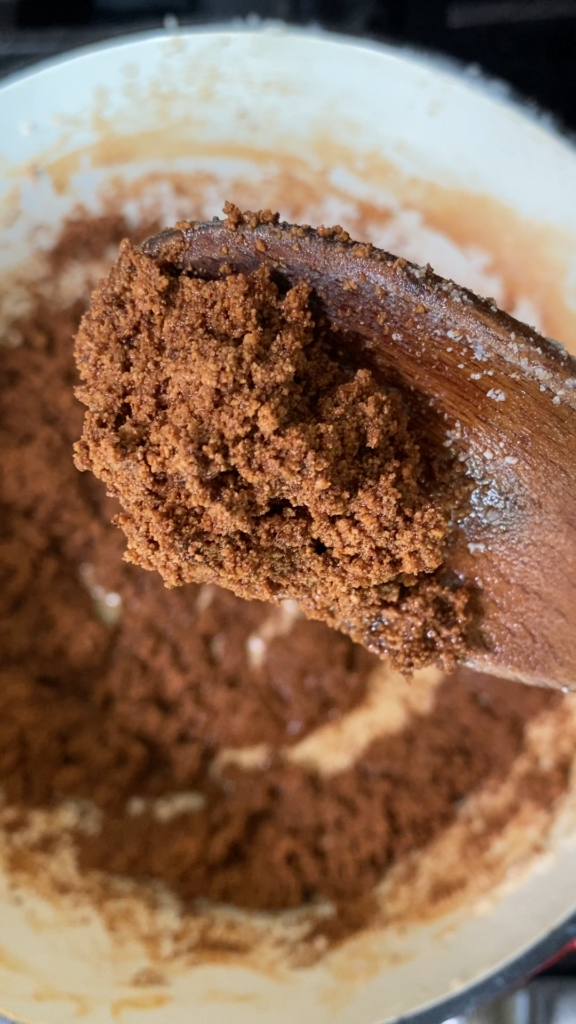
When I made this using the Kara UHT (Ultra High Temperature) coconut cream, the latik was lumpy and had very little coconut oil separation. The latik ended up darker and crispier.
Using the Kara coconut cream in a can, there was a LOT of coconut oil and the latik ended up lighter and softer.
In this specific comparison I prefer the regular coconut cream in a can for latik but to be honest, it is not that much different.


Coconut Milk vs Coconut Cream vs Coconut Beverage
This recipe uses coconut cream.
It can be a challenge to navigate the different coconut based ingredients. Both coconut milk and coconut cream are (ideally) simply just coconut and water. Coconut milk is thinner with higher water content than the thick coconut cream. Coconut cream has a higher fat content and is usually used when you need a thicker consistency.
Both coconut milk and coconut cream are commonly found in a can or carton. If you were really pressed, you could make coconut milk by simply adding water to coconut cream.
Coconut beverage is sometimes labeled as coconut milk but in the context of plant-based milk alternatives like soy milk, almond milk, oat milk, etc. I’m sure there are recipes out there that call for this but I’ve never made anything that calls for it so when I see “coconut milk” I assume it is the canned product.
Step by Step Photo Guide
I provided these photos of the process as a guide but do not worry if yours looks different (unless its burnt) because every coconut cream is slightly different.

I’m using the Kara coconut cream can here. 2 of them to be exact


On the left, the coconut cream is starting to simmer. On the right, it is beginning to separate


On the left, the solids have almost fully separated from the oil. On the right, the separation is complete and the oil has cooled down a little

Strain the curds from the oil and you’re done! All this from 2 whole cans!
Other Recipes You Will Like
I’ve updated this recipe because at the time of writing I am working through a video series on kakanin which is Filipino rice based desserts. I have recipes for all of them:
- Puto is a soft and fluffy rice cake topped with something salty. In my case, American yellow cheese.
- Cassava Cake is a bouncier flan that uses cassava as a base. It is topped with custard.
- My siblings fight over kutsinta, a sugar and glutinous rice mixture that is steamed.
- Palitaw is probably the most basic and easiest kakanin you can make.
- My personal favorite kakanin is biko. It is a caramelized sticky rice dessert